Showing posts with label News. Show all posts

Monday, December 28, 2015

Only $45.95 Get Wondershare Video Converter Ultimate - Video Converter, Download, Creator, Transfer

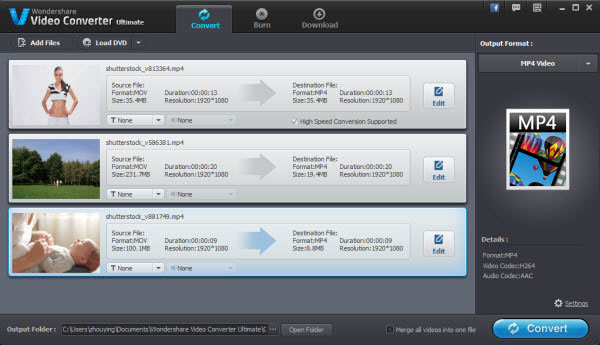
With its broad format support and super practical user interface, Wondershare Video Converter Ultimate deserves to be called a good video converter, especially since it includes basic editing and authoring, DVD burning, and downloading from popular video streaming Web sites. Fortunately, the price is very cheap, only $ 49.95.


A Full Range of Compatibility
159 formats supported and counting! New formats are constantly added making the Video Converter Ultimate the most user friendly video converter on the market. Enjoy the latest addition to the VCU in the new 4K video format! With 4K, enjoy the absolute best and finest picture quality today!
  
Enjoy HEVC/H.265 4K Video
High Efficiency Video Codec (HEVC) is the successor to the H.264 compression standard and offers twice the compression while still maintaining the same high quality. This means you can store your UHD on your devices at half the normal file size!

Download YouTube Video – with One Click!
When you play a video in any major browser, a smart Download button will automatically appear. With just a click, you can enjoy the video anytime – without an internet connection. Or convert it to watch on your TV, smartphone, or another device. In addition, you are able to download YouTube MP3 directly and YouTube playlists in batches with high speed. YouTube subtitle download is also available.

A Flawless DVD Experience – Anywhere
Want to watch your movies on the go? Convert them to high-quality files specifically optimized for playback on your favorite devices: iPad Air 2, iPhone 6S (Plus), iPhone 6 (Plus), iPod Touch 6, Samsung Galaxy Note 5, Galaxy S6 Edge, Xbox, PlayStation Vita, Nexus, Kindle Fire, and many more smartphones, game systems, and tablets.
Or enjoy your home videos on the big screen. Make a professional quality DVD for personal use from one or multiple files with included DVD menu templates.

30X Faster Video Conversion
We're the fastest solution on the market – by far. Head-to-head comparisons reveal that Video Converter Ultimate doesn't just surpass competitors – it leaves them in the dust – with a speed that's 30 times faster.

Streaming Your Media to TV Couldn't Be Easiernew feature
Still glued to the tiny screen of your PC? It's time to embrace your TV's big screen, in the comfort of your home. No need for an external hard drive or a USB cable. Let's go wireless! In one click, Video Converter Ultimate, streams your media files on a PC to a smart TV directly or to a standard TV via media streamers like Chromecast (Roku, Apple TV, Xbox 360 or PS3). As long as your PC and smart TV or media streamer are connected to the same network, Video Converter Ultimate's Media Server plugin will work for you. All video and audio formats are supported. See how it works here.

Perfect DLNA Support Built Innew feature
Video Converter Ultimate's Media Server plugin makes your media decent on all DLNA certified devices like Xbox 360, Xbox One, PS3, and DLNA supported mobile apps including Wondershare Player. With the powerful Media Server, your computer's files can be accessible on all kinds of platforms like phones, tablets, TVs and more. Just enjoy it.

Transfer Video Without USB Cable
Move videos to your Apple and Android devices without using a USB cable! You can instantly transfer the converted and downloaded videos to your mobile devices via existing Wi-Fi network, and enjoy them right away on your portable devices.

Enjoying your videos just got simpler. Now you can watch anytime, anywhere. Alter, enhance, convert – whatever you do – the final result will be in perfect quality ( even in high-definition or 3D) no missing key frames, redraw issues, or crashes.




How-To:
About H.265, Best H.265 HEVC Converter and How to Convert H.265 on Windows/Mac
Convert Videos to H.265 MP4/MKV on Windows 10/Mac OS X El Capitan
ncode Samsung NX1 H.265 footage to MOV, MP4, AVI, WMV for editing, burning or playing
How to Play MP4 video on PS4 from USB Drive?
Play MKV, AVI, VOB, M4V, M2TS, H.265, WMV, FLV, Tivo videos on PS4
Multiple Ways to Add lossless FLAC files to iTunes and iPhone/iPod/iPad
Play MKV movies on your Android tablet or smartphone
Play MKV, AVI, M4V, FLV, VOB, WMV, Xvid Videos on Galaxy S6/S6 Edge
Watch 2K/4K, HD and Common Videos and Movies on any Kids Tablets
Encode MP4 to MPEG-2 for Playing in TV stations, TV receivers, DVD players, Non-linear editing software
 

Thursday, April 24, 2014

Panasonic Lumix GH4 4K Flagship


Panasonic announced after the first generation of LUMIX G flagship GH4, seems to attract a lot of users to inquire about offering news came today Panasonic Lumix GH4 conference was finally held in Hong Kong, 《Price》 will certainly not miss the opportunity, for the first time everyone GH4 collecting information! 


Lumix GH4 main shoot 4K, 16.05 million pixels Digital Live CMOS sensor with newly developed Venue Engine image processor, so that the quality has greatly improved; GH4 more support 4K video recording without time limit, provided the recording of up to 200 Mbps options! In addition, the continuous shooting function GH4 also worth talking to a maximum 12 fps (AFS) can produce 40 continuous shooting RAW and 100 non-RAW images, there are requirements for high-speed continuous shooting friends should be very satisfied with it?

Wednesday, March 5, 2014

Hong Kong Film New Action – 4K Movie Power

"Hong Kong Film New Action – 4K Movie Power" is organised by Create Hong Kong and the Hong Kong Film Development Council, and co-organised by the Association of Motion Picture Post Production Professionals (AMP4) and Hong Kong Productivity Council. The event with its focus on the future of 4K Movie, consists of two workshops, A thematic symposium and an exhibition booth displaying the related technologies, will be held during Filmart. Various aspects of 4K Movie such as production, post production, cinema & global delivery will be covered.

Workshop Entrance Overview

A. 4K Digital Movie Making
  • Date: 21 March (Fri) & 22 March (Sat)
  • Time: 0900 –1800/ 0900-1900
  • Venue: A001, HKDI  • Fee (HKD): 600 • Seats: 150

B. Professional 4K Movie DIT and DMT Workshop
  • Date: 22 March (Sat) – 23 March (Sun)
  • Time: 1430 –1700/ 0900-1900
  • Venue: A001, HKDI
& 
  • Date: 24 March (Mon)
  • Time: 0800-1600
  • Venue: Comix Home Base, Wan Chai • Fee (HKD): 2,400 • (Interested party who would like to join both workshops can have 50% tuition fee covered of the class '4K Digital Movie Making') • Seats: 30

Admission Requirements
  1. Permanent resident of HKSAR
  2. Strong interest to join the digital cinema industry
  3. Basic knowledge of digital movie production and distribution

First Come First Serve ! Full detail download the pdf here. You can register online here.

Source: HKCPUG

Asus Zenbook NX500 4K ultrabook on the way

Asus is reportedly working on a new 15 inch ultrabook with a 4K, Ultra HD display. It's called the Asus Zenbook NX500 and the laptop reportedly an aluminum body, an anti-glare display, and Bang & Olufsen audio.


The Zenbook NX500 wouldn't be the first 15 inch ultrabook from Asus. It'll likely replace the aging Asus UX51 line of ultrabooks which have measly 1080p touchscreen screens and Intel Ivy Bridge processors.

Details about the new model are pretty scarce, but it seems likely the laptop will have an Intel Haswell CPU, and I wouldn't rule out a discrete graphics card to help power the Ultra HD display (Intel's integrated graphics could probably get the job done without any help, but Asus tends to charge premium prices for its 15 inch Zenbooks, so the new model will probably have the premium specs to match).

I've always been a bit wary of lumping 15 inch and large ultrathin notebooiks into the same category as smaller “ultrabooks,” when they can weigh as much as 5 pounds. But an Asus laptop that measures less than an inch thick, weighs less than 5 pounds, and has a 4K display certainly sounds like something to keep an eye out for.

Via Notebook Italia
  

Tuesday, March 4, 2014

Taiwanese 4K TV Panel Makers Taking Lead, Says NPD DisplaySearch

NPD DisplaySearch just published its predictions about which companies will be making the most 4K TV panels in 2014, according to which Taiwanese manufacturers will for the first time have overtaken Korean brands by producing more than half of the world's panels.

The study shows Innolux and AUO to account for 58% of global 4K panel shipments in 2014, followed by Koreans LG Display and Samsung Display, which, combined, fall well behind at 25%, followed by Chinese brands, ChinaStar and BOE, at 14%.


The sudden surge among Taiwanese panel manufacturers can be attributed to high demand from the Chinese market, where 4K panels are used in entry-level and mid-range TVs. ChinaStar is expected to sell 90% of its 2014 4K panels to the biggest Chinese TV makers (TCL, Hisense, Skyworth, Konka, Changhong, etc.), while BOE, Innolux and AUO plan to ship the majority of their panels (70%, 57% and 56% of their stocks, respectively) to the same brands. Koreans LG and Samsung, on the other hand, are opting to save their Ultra HD panels for only their highest-end TV models like the LG LA970V and Samsung F9000, resulting in lower annual volume.

Says Debra Yang of DisplaySearch, "the 4K display demand from their related TV brands is critical to the ability of Samsung Display and LG Display to compete effectively within the growing 4K TV market. The ability of the Korean panel makers to expand 4K panel production is dependent on their success in securing more 4K display clients, beyond satisfying the needs of their own 4K TV brands."

"The rise of the 4K TV market is mainly driven by the supply side, while leading TV brands are concerned about the value proposition of 4K TVs. While some TV brands are considering increasing their 4K TV shipment targets, we continue to see a mismatch between 4K TV panel supply plans and consumer purchasing expectations."

Sony Xperia Z2 4K video recording from the air

As everyone knows, any story that goes a helicopter instantly improves. And it is not the same stroll through Barcelona to test the latest camera or mobile to portray and save the city from the sky.


Aware of this, Sony Mobile chose to celebrate in style-pun intended-the arrival of your Xperia Z2 at the Mobile World Congress and took the helicopter ride press. A good opportunity to premiere the video recording mode with 4K counts based on Android and this is undoubtedly one of the most outstanding new smartphone.

It is true that, from a strictly technical point of view, are not the best circumstances for this test: a crystal interposed between the camera and the landscape, the harsh light of midday, it was three in the afternoon-the constant shake a helicopter ... But the truth is that it was one of those proposals that is hard to resist.

Half an hour of flight and travel back and forth between Barcelona and Montserrat-record we try to best-in 4K. Are We Ranked footage? Not as much as one might fear a priori, with a rate of about 400 MB per minute of recording. Something that logically implies that it has a rather high compression applied with corresponding effects on the fine details of the image.

This first test gives a fairly predictable results. The quality is good, at the height of the best Full HD video that can be obtained with a smartphone, but four times larger (3840 x 2160 points). After all, for that matter.

Video recorded with Sony Xperia Z2 in 4K resolution. To see it in this resolution, select "2160p 4K" option in YouTube quality settings.
 
That 4K is here to stay is evident. Take more or less sneak into homes, but so far as the recording devices are doing their homework.

But it is a mobile, of course, so you are also limitations there. For example, there are obvious problems with the dynamic range and the rolling shutter effect, clearly seen especially in the higher levels of jitter. The new image stabilizer does its job, but it is true that in such extreme conditions can not expect miracles.

But does it make sense to record 4K video with a mobile? Is the obvious question whenever a device with this functionality hits the market, and the new Xperia Z2 is no exception. While it is true that without some resolution of this TV can do, the good news is that YouTube already allows us to store the videos on this pending resolution have a display conditions. 

In any case, there is only 4K. Record clips with this resolution can also be an advantage when performing post production and full HD video mount leveraging that excess pixels to improve the bottom line.

Actually this is the same debate at the time lived around high resolution. That 4K is here to stay is evident. Take more or less sneak into homes, but so far as the recording devices are doing their homework. Sure like to have some advance too.

Monday, March 3, 2014

4K & 4G LTE Rockchip RK2388 Tablet Processor Due In April

Rockchip is launching a new generation of processors for tablets this year and the new R3288 is coming in April it appears. The CPU is supposed to integrate 4G LTE network support and we’re expecting it on affordable tablets.


This is actually one of the first quad core Cortex A12 SoC product on the market and the CPU relies on a powerful quad core Mali T76X GPU. This allows for H.265 decoding, 4K video and as we said, 4G LTE. We’ve been hearing rumors about 4K display tablets for a while now, but we haven’t even seen the 2K models yet.

Since theoretically even lower end CPUs have 4K support, it would be high time for device makers to release such slates. Traditionally Rockchip has rivals like Allwinner, MediaTek and such, so expect similar processing solutions from them, or even better.

Source: Tabletnews

Future is fuzzy for 4K, ultra-high-definition TVs

4K programming has finally arrived for UHD TVs -- slowly.

Samsung's curved 4K ultra-high-definition TV uses the Internet streaming services of Comcast, Netflix, and Amazon for content.

Around this time last year, TV manufacturers trumpeted the arrival of 4K ultra-high-definition televisions. The pricey and often humongous TVs pack in four times as many pixels as top-of-the-line HD sets.

But new technology often faces a chicken-and-egg problem. Even if you bought a 4K UHD TV, what would you watch on it? Very few movies support the new resolution. Some Blu-ray players promise to convert regular high-definition video to something approximating ultra high definition, but such techniques are stopgap solutions while TV makers wait for Hollywood to catch up. Instead, online companies such as Netflix and YouTube have taken the lead.

"This year, we started to see delivery of 4K content, but what might be surprising to some is that [4K] streaming video will likely be first," says Steve Koenig, director of industry analysis for the Consumer Electronics Association.

On Feb. 14, the second season of "House of Cards" premiered on Netflix in 4K. The video-streaming service will also present all five seasons of "Breaking Bad" and many of Netflix's future original series in 4K.

YouTube has embraced a new way to encode video, one that will make it easier to handle ultra high definition. And Samsung teamed up with Comcast to create an online 4K video service that will run on Samsung TVs.

To enjoy this superior picture quality, you will need a UHD TV and an Internet connection of at least 15.6 megabits per second, according to Netflix. That's in line with some cable-modem speeds, but well beyond a DSL connection.

Cramming all that data onto a disc has been a problem for Hollywood. A 4K movie takes up about 100 gigabytes, according to Samsung. Most Blu-ray discs top out at 25 gigabytes. DVDs hold only 4.7 gigabytes. The group behind Blu-ray recently approved discs that can handle a full 4K movie, but studios have been slow to turn them around.

Right now, there's little reason to rush. The average TV size in the United States jumped from 22 inches in 1997 to 39 inches last year. But from a normal viewing distance, the human eye can't see the difference between HD and UHD until you get to 50- or 65-inch televisions. With current UHD TVs costing thousands of dollars, Hollywood can take its time – and the chicken-and-egg problem continues.

This article originally published at CSMonitor

Qualcomm Snapdragon 805 4K tablet hands-on review

We check out the performance of Qualcomm's new ARM-based super chip for tablets

Mobile World Congress 2014 saw a wave of new processors appear on the scene. This kicked of with Intel, when it launched a major offensive into the smartphone market, unveiling its dual-core Merrifield and quad-core Moorefield Atom processors. Not wanting to be outdone by the PC heavyweight, Qualcomm answered back, unveiling its latest top-end Snapdragon 805 64-bit processor.

Performance

On paper the Snapdragon 805 is pretty impressive. Built up of four Krait 450 cores with a maximum clock speed of 2.7GHz, the chip also integrates an Adreno 420 GPU and 128-bit memory interface. But a chip by itself is never the whole story, and it's all about how it works with the other parts and software in the device.


We got to test the Snapdragon running inside several demo Android tablets at Qualcomm's MWC stand, and we were very impressed by how well they ran. Trying out the first tablet with a variety of pre-installed applications, the device was lighting fast. We were particularly impressed with how well it dealt with heavier, more demanding tasks such as 1080p 3D gaming.
We're guessing this is due to the chip's upgraded Adreno 420 GPU, which is listed as offering 40 percent better performance than the older 320. It's also likely a consequence of the fact that the Adreno 420 GPU supports new hardware tessellation and geometry shaders for 4K rendering.

Hardware tessellation is a feature traditionally only seen in discrete GPUs for PCs and it has only recently been incorporated into DirectX and next-generation games consoles such as Sony's PS4 and Microsoft's Xbox One. For us the feature's inclusion on the Snapdragon 805 is sign that Qualcomm is working to further close the gap between PCs and tablets.

4K ultra HD resolution display

We noticed the biggest Snapdragon perk on a second tablet, which had a 10.1in 4K ultra HD 3840x2160 resolution display. This display quality is only possible on the tablet thanks to the advanced GPU and CPU combination in the Snapdragon 805, and we have to concede that the 4K display is a serious technical achievement.

Viewing a variety of images on the device, we found it one of the crispest and sharpest displays we've seen on a tablet. From, what we've seen of the test device so far, the display easily beat the iPad Air's performance. Holding the tablet as close to our face as we could, we still couldn't discern individual pixels on the screen.


As an added bonus the Snapdragon 805 also offers 4K video playback, featuring support for the hardware 4K HEVC (H.265) decode for mobile. Sadly, we didn't get a chance to test this during our hands on.

Chances

There's currently no word about when the first Snapdragon 805 tablets will be go on sale, but from what we've seen of the Qualcomm demo devices, we're pretty excited. The demo tablets we tried seemed lightning fast and, while we didn't get a chance to benchmark them, they did seem to offer substantially improved performance on Qualcomm's previous Snapdragon 800 processor.

That said, the real question isn't how the Snapdragon 805 compares with the 800, it is how it will match up to the performance of Intel's Moorefield. We're yet to get a chance to test this, but with Dell, Lenovo and Asus confirmed to be working on devices using the upgraded Atom chips, hopefully we won't have to wait long to do so.

Wednesday, February 26, 2014

Qualcomm demos 4K Android gaming tablet at MWC 2014

Qualcomm demos 4K Android gaming tablet
The first Android tablet equipped with Qualcomm's new Snapdragon 805 processor was on-hand at Mobile World Congress in Barcelona.

The Verge got to try it out, and the tech site said that "it's good, it's very good." They played existing games including Asphalt 8: Airborne and Injustice: Gods Among Us and seemed impressed. Since the games' textures and graphics were designed for lower resolutions, "they don't look as awesome as they could, but the sheer fact that they can be run at 4K with a perfectly playable frame rate is impressive," the site said.

The Qualcomm tablet on display at the tech show appears to be merely for demonstration purposes, though. Qualcomm announced the new Snapdragon chip last November, but it's not due to show up in any retail devices this summer. When it does, though, 4K resolution tablet gaming may well become the new standard.

There's debate as to whether jamming so many pixels onto the relatively small screens of tablets and smartphones will actually provide much benefit to the human eye, but that seems to be the direction the industry is headed regardless.

More Related:
 

Thursday, February 20, 2014

News: 4K House Of Cards Won't Be Gentle On Usage Caps

We've already noted how bandwidth caps likely won't fare very well with the arrival of 4K video, even with the help of next-generation compression codecs. Netflix CEO Reed Hastings is already on record stating their upcoming 4K streams will need at least 15 Mbps and would be most optimal with 50 Mbps. Sony's upcoming 4K film service will similarly plow through gigabytes like a hot knife through butter. 

With everybody currently binge watching Netflix's "House of Cards," Gizmodo quite correctly points out that binge-watching the series in 4K will be anything but gentle on your bandwidth cap:

quote:
Streaming in 1080p on Netflix takes up 4.7GB/hour. So a regular one-hour episode of something debiting less than 5GB from your allotment is no big deal. However, with 4K, you've got quadruple the pixel count, so you're burning through 18.8GB/hour. Even if you're streaming with the new h.265 codec—which cuts the bit rate by about half, but still hasn't found its way into many consumer products—you're still looking at 7GB/hour. 
But you're not watching just one episode, are you? Of course not! You're binging on House of Cards, watching the whole series if not in one weekend then certainly in one month. That's 639 minutes of top-quality TV, which in 4K tallies up to 75GB if you're using the latest and greatest codec, and nearly 200GB if not. That means, best case scenario, a quarter of your cap—a third, if you're a U-Verse customer with a 250GB cap—spent on one television show. Throw in a normal month's internet usage, and you're toast.
It's even worse for many DSL users, whose caps are as low as 150 GB. And a few scattered ISPs (not even mentioning satellite broadband) take the cap limbo lower than that. Broadband ISPs have always insisted that their usage-caps would scale with necessity (instead of being tightened like a noose to hamper video competitors), and 4K video appears to be something that could test that claim.

Wednesday, February 19, 2014

Avatar trilogy of sequels to be shot in 4K, 48 fps high frame rate

James Cameron will shoot the three upcoming Avatar films in 4K resolution, and partially using the 48fps high frame rate format.

Avatar films in 4K resolution

James Cameron has made a career out of pushing the boundaries of technology in his movies, and once again the director is planning on using the most cutting edge tech to film the three upcoming Avatar sequels. The trilogy of sequels will be shot back-to-back-to-back in 4K, and will at least partially use the 48fps high frame rate format recently seen in The Hobbit films, the director told the French outlet RTL.fr (which was then translated by TechRadar).

Films are typically shot in 2048 x 1080, but Cameron is proposing moving to 4096 x 2160. The director's move to Ultra HD isn't really that surprising given his love for using new technology. Cameron's choice to shoot the original Avatar in 3D led to a major windfall, as the film went on to earn close to $2.8 billion worldwide. Avatar certainly wasn't the first 3D film, but it remains the most successful. That helped to spur the current 3D film trend, where for a while it seemed like Hollywood's new passion would help to usher in the age of the 3D TV. That hasn't quite been the case, but with 4K TVs hitting the market, Cameron could once again help to push the new tech into the public consciousness.

"You know we'll be shooting at a native resolution probably of 4K and so there should be a lot of true 4K theaters by then as well," the director said.

The frame rate may be a bit of a tougher sell though. When The Hobbit: An Unexpected Journey debuted its 48fps HFR version, it was divisive. Some loved the realistic look, while others derided it as "too-realistic," criticizing it for supplanting the textured cinematography audiences expect. It also highlighted what some saw as other technical failings that were unique to HFR, including lighting made for 24fps that was almost fluorescent in the new format. That didn't seem to hurt the box office though, as the first two films of the trilogy have earned nearly $2 billion worldwide.

While Cameron has embraced the Ultra HD wholeheartedly, he is still studying the HRF format. It will be used in the coming Avatar films to some degree, the question is how much.

"Well we're looking at high frame rate: I'm studying that," said Cameron. "I haven't made a final decision yet, whether the entire film will be made at a high frame rate or only parts of it."

Filming on the planned trilogy is set to begin in 2015, with all three films combined expected to cost upwards of $1 billion. Filming them together will help to speed up the process though, and the films are tentatively set for December releases in 2016, 2017, and 2018.

Do you really need a 4K smartphone screen?


See those two screens up there? Pretty soon the smartphone will have the same resolution as the much bigger panel (a 27-inch Dell U2711 monitor with 2,560 x 1,440 pixels). While the snappiest CPUs, more RAM, better cameras and other frills are a must for the latest handsets, the current marketing pièce de résistance is a higher-resolution screen. In four years, we've passed from a norm of 800 x 480 to 960 x 540 and up to 720p, 1080p and soon -- likely on Samsung's upcoming Galaxy S5 -- 2,560 x 1,440 Quad HD (QHD). That works out to a borderline-insane 500-plus pixels per inch (depending on screen size) and manufacturers aren't stopping there. But is more resolution worth the extra expense if you can't even see the difference? Well, it's complicated.


The first smartphone with Quad HD, the 6-inch Vivo Xplay 3S (pictured above), has already been announced. Others that could have that pixel count, like Samsung's Galaxy S5 and the Oppo Find 7 are rumored to be launching at Mobile World Congress next week. As a reality check, that's the maximum supported by most 27-inch and larger pro monitors, apart from several recently announced 4K models. While such screens pack a pixel density of about 110 ppi, the Vivo Xplay 3S handset clocks in at a whopping 490 ppi, more than four times as much. Most people (according to Apple) hold their phones about 10 inches from their eyes, but sit only a touch more than twice that distance from their monitor -- around 24 inches on average.

Are higher pixel counts worth the manufacturing cost and effort? In justifying the Retina display on the original iPhone 4, Apple famously said that the human eye could only resolve about 300 ppi from 10 inches. That seems to have merit considering that most glossy magazines are (effectively) printed at 300 ppi, and no one complains about the resolution of magazines. Others have said that it's possible to distinguish pixels up to about 480 ppi or even more, but that requires closer viewing distances and perfect, youthful eyesight. Most of us fall somewhere between those extremes, depending on our age and the state of our orbs.

If you're willing to allow that 480 ppi or so is the maximum resolution the best of us can see, then guess what? We're already there, pretty much. LG's Nexus 5 (above) for example, has 1,920 x 1,080 pixels jammed into its relatively petite 4.95-inch screen. That works out to 445 ppi, far in excess of Apple's first Retina display and, for this editor, completely artifact-free at eight to 10 inches, even on fine fonts. You could make the case that Vivo's much larger 6-inch phone is deserving of its 490-ppi Quad HD screen. But then again, six inches is pushing into tablet territory, and you'd probably hold such a phone farther from your eyes -- Apple figures on 15 inches for an 8-inch iPad mini with Retina, for example. From that distance your eyes will resolve less (again, assuming you can even see that close), negating the need for more pixels.

At about 3.7 megapixels, a Quad HD screen has nearly twice the resolution of a 1080p model (2.1 megapixels). Those extra pixels aren't going to push themselves around, meaning you'll need beefier graphics if you want to keep the whole "butter" thing going. Of course, Samsung's upcoming flagship will likely be powered by a state-of-the-art Snapdragon 805 or Exynos 6 CPU if the rumors pan out. However, with the extra resolution, you may not get a corresponding performance boost. On top of that, unless the Korean company's pulled off some coup, battery life may be the same or worse than the current Galaxy S4. All that means you might be sacrificing a lot of your smartphone's other capabilities in exchange for pixels that are (arguably) imperceptible.


Despite our reservations, pixel progress marches on. Japan Display announced 5.4- and 6.2-inch Quad HD panels; LG has at least a 5.5-inch screen incoming (above); and Qualcomm showed off a 5.1-inch 2,560 x 1,440 model. Along with Vivo's 6-inch display, that covers a wide gamut of screen sizes, most of which are bound to show up in new models this year. And if the rumors are true about Samsung's Galaxy S5, it'll be QHD with a 5.2-inch screen size -- that's 560 ppi, if you're keeping score at home.

It seems that's not enough, because Samsung has already said that it'll have 3,840 x 2,160 (4K) screens out by 2015 with 700 to 800 ppi, depending on screen size. Even the most ardent pixel-lovers would have to agree that's crazy, passing the limits of human acuity and matching 110-inch 4K home theater panels pixel-for-pixel. Naturally, we want our tech dripping from the bleeding edge and we love us some 4K. But after Quad HD becomes the gold standard later this year, manufacturers should focus on more important things like battery life, user experience and design. Don't hold your breath, though, because smartphone marketers love bigger numbers -- even if, like the emperor's clothes, you can't actually see the extra pixels.

This article originally published at Engadget

Monday, February 17, 2014

Is Apple's Alleged iPad Pro Really a Good Idea? Some Suggest There's Just No Call

Apple is expected to launch a 12-inch iPad Pro hybrid later this year, but not everybody is convinced it's a good idea…or even that it will happen.

Apple's fabled iPad Pro has been the talk of the town for quite some time, but there are some industry insiders out that that aren't convinced we'll ever see the device brought to life.

And if we do, they don't think it will work out nearly as successful or lucratively as Apple and the rest of us seem to think.

It's pretty obvious and undeniably interesting idea on the whole. Apple's iPad Pro is said to be a gigantic 12-inch tablet PC that's built alongside a special docking station that transforms it into a fully-functional laptop. As such, buyers are in essence able to take home the best of all worlds – iPad plus MacBook – for one mid-range price.

Market-wise, the iPad Pro is tipped to be aimed at educational institutions and corporate buyers, while the standard consumer public will of course beat a path to its door…as always.

But here's the thing – does the iPad Pro really have any legs, or is it a case of pure hype and curiosity clouding better judgment?

Well, as far as the folks over at Motley Fool are concerned, it's more a case of the latter.

We know that Apple secured a patent to the kind of technology the iPad Pro demands and we also know that hybrid devices of a similar nature or nothing new. The thing is though, while tablet PC sales are once again expected to blow the roof off the tech industry throughout 2014, Gartner belies that the market for hybrid devices will climb at a much slower pace, improving just 5% on last year's sales.

And compared to standard tablet PCs, last year's hybrid sales were pretty paltry to say the least.

Which is where the theory begins to take shape – it's suggested that Apple really doesn't have enough justification or call for a device like the iPad Pro to push it out just yet. Educational and corporate markets haven't taken to hybrid devices nearly as quickly or unanimously as expected, so there's no guarantee the iPad Pro would be the device to make.

Of course, it's all pure speculation for the moment as Apple hasn't said a word on the subject either way. Food for thought though if nothing else – in the absence of an iPad Pro, where exactly will Apple take the iPad next time around?

Over to you…

This article originally published at HIGHLIGHTPRESS